
Key Takeaways
- How to fix an overbite depends on its cause, severity, and whether the issue involves tooth position, jaw position, or both.
- If you are wondering if braces can fix an overbite, they may help correct many tooth-related bite problems, although some cases can require other orthodontic or dental treatment.
- Understanding what causes an overbite or what causes an underbite can help explain why treatment plans differ from person to person.
- Crossbite treatment may involve orthodontic appliances, braces, aligners, or other approaches depending on which teeth or jaw structures are affected.
- Bite problems are not always only cosmetic. In some cases, they may affect chewing, tooth wear, or how the teeth fit together over time.
A bite problem can be easy to overlook, especially when it does not cause immediate discomfort. But an overbite, underbite, or crossbite can involve more than the way a smile looks. The position of the teeth and jaws may affect how biting forces are distributed, how the teeth wear, and, in some cases, how comfortably a person chews.
The important point is that these conditions are not all corrected in the same way.
At Miller Dentistry, bite concerns can be evaluated by looking at the relationship between the teeth, the jaws, and the patient’s overall oral health before recommending an appropriate next step.
What Is the Difference Between Overbite, Underbite, and Crossbite?

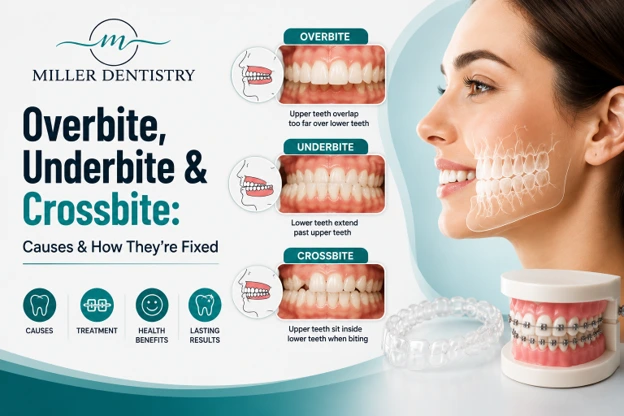
These terms describe different ways the upper and lower teeth or jaws may not align as expected.
Overbite
An overbite occurs when the upper front teeth overlap the lower front teeth vertically. Some degree of overlap can be normal, while a more pronounced overbite may require evaluation.
What causes an overbite? Possible contributing factors can include genetics, jaw development, tooth position, certain childhood habits, and changes in how teeth erupt. In some cases, the primary issue is the position of the teeth. In others, the relationship between the upper and lower jaws plays a larger role.
Underbite
An underbite generally occurs when the lower front teeth sit in front of the upper front teeth. It may result from the lower jaw developing farther forward, the upper jaw developing differently, tooth-position issues, or a combination of factors.
What causes an underbite? Genetics and jaw growth patterns can be important contributors. Because an underbite may involve the jaws rather than only individual teeth, treatment can vary considerably.
Crossbite
A crossbite occurs when one or more upper teeth close inside the lower teeth. It can affect the front teeth, back teeth, or one side of the mouth.
This is one reason crossbite correction should begin with identifying the specific type of crossbite. A problem involving a single tooth may be approached differently from one involving the width or position of the jaw.
How Dentists Approach Bite Correction: Teeth, Jaws, or Both?
One useful way to understand bite treatment is to ask three questions:
- Is the problem mainly related to teeth? If so, orthodontic treatment may help guide teeth into a more appropriate position.
- Is the problem mainly related to jaw development? Some bite concerns are more closely connected to the size or position of the upper or lower jaw.
- Is it a combination of both? Many cases involve elements of tooth alignment and jaw position, which is why two people with what appears to be the same bite problem may receive different treatment recommendations.
This teeth-versus-jaws distinction is important. The visible appearance of a bite does not always reveal what is causing it.
How to Fix an Overbite
For people searching for how to fix an overbite, treatment may depend on the severity of the bite and its underlying cause.
Can braces fix an overbite? Braces can help correct many overbites by moving teeth and improving how they fit together. Clear aligners or other orthodontic appliances may also be appropriate in some situations.
However, braces alone may not address every type of overbite. When jaw position or skeletal development is a significant factor, a different or more comprehensive approach may be considered.
The goal is not simply to make the front teeth appear straighter. A thorough evaluation also considers how the upper and lower teeth function together.
Crossbite Treatment: Why Timing and Cause Matter
Crossbite treatment may involve braces, clear aligners, expanders, or other orthodontic approaches, depending on the patient’s age and the type of crossbite.
Early evaluation can be useful for children because the teeth and jaws are still developing. That does not mean every crossbite requires immediate intervention, but it can help a dentist or orthodontic professional identify whether the bite should be monitored or treated.
For adults, crossbite correction can also be possible, although the recommended approach may differ depending on the teeth, bone structure, and complexity of the case.
What Happens If a Bite Problem Is Left Untreated?
Not every overbite, underbite, or crossbite leads to serious complications. Still, certain bite problems may contribute to uneven tooth wear, chipping, difficulty chewing, gum stress, or changes in how forces are distributed across the teeth.
A crossbite, for example, may create uneven contact between opposing teeth. Whether this leads to significant problems depends on the individual case.
That is why the best question is often not, “Does every bite problem need treatment?” but rather, “What is this particular bite doing to my teeth and oral function?”
When Should You Have Your Bite Evaluated?
Consider a dental or orthodontic evaluation if you notice:
- Difficulty or discomfort when biting or chewing
- Teeth that appear to wear unevenly
- Repeated chipping or cracking
- A visible change in how the upper and lower teeth meet
- A child whose teeth appear to close in an unusual position
- Concerns about the appearance or function of your bite
At Miller Dentistry, evaluating bite concerns can help determine whether monitoring, orthodontic treatment, or another approach may be appropriate.
FAQs:
Q. What is the hardest bite to fix?
Ans: There is no single bite type that is always the hardest to correct. Complex cases involving significant jaw-position differences, severe tooth misalignment, or multiple bite problems may require more extensive treatment planning.
Q. What happens if you never fix a crossbite?
Ans: The effects can vary. Some crossbites may remain relatively stable, while others may contribute to uneven tooth wear, abnormal biting forces, or other functional concerns over time. An evaluation can help determine the potential significance of a specific case.
Q. What is a stage 3 underbite?
Ans: “Stage 3 underbite” is not a standard term used universally to classify underbites. Bite severity may instead be described using orthodontic or skeletal classifications, so it is best to ask a dental professional how an individual underbite is being categorized.
Q. Do overbites get worse as you age?
Ans: Some overbites may change over time because teeth can shift, and jaw or bite relationships may evolve. However, progression varies by person and depends on the underlying cause of the overbite.